
A Design For Dementia
81 to 83 Perth Road
Dementia is one of the fastest-growing health challenges in the United Kingdom, yet most care environments remain generic, requiring individuals to adapt to unfamiliar settings as their condition progresses. This project challenges that approach through the story of the architect's grandfather, Luigi, who has lived in his Wood Green home since 1971. Despite his dementia, he continues to navigate the house with ease, demonstrating how the body retains spatial routines long after other memories begin to fade.
The proposal leaves Luigi’s home unchanged whilst transforming the vacant mirror-image house next door into a home for his carer. As Luigi’s perception of time gradually shifts backwards, the adjacent house reconstructs familiar places, routines and media from earlier decades, creating an architectural stage set that aligns with his understanding of time rather than forcing him to conform to the present.
Recognising the difficulty of realising such a project at a full architectural scale, the proposal is condensed into the Memory Cabinet, a miniature architecture of reminiscence that reconstructs personal memories as environments that can be opened, explored and shared.
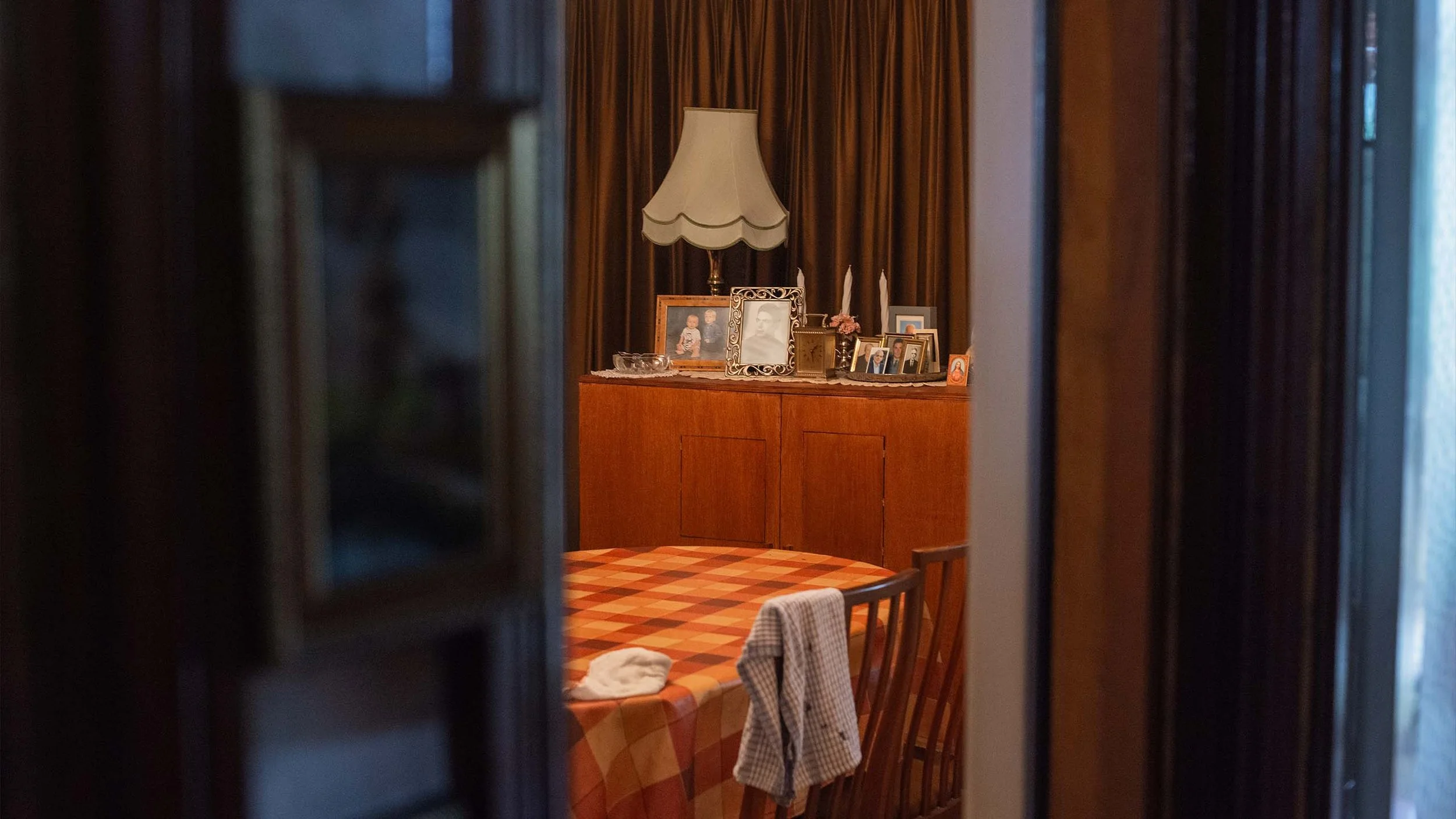
The Cabinet of Memories
The Architectural concept forms into a single furniture piece. Seen through Luigi's perspective, this cabinet unfolds like a stage set. It uses sliding panels, doors, and images to reconstruct memories through familiar spaces and daily routines.
The Architecture of Framed Shrines
The Architectural concept forms into a single furniture piece. Seen through Luigi's perspective, this cabinet unfolds like a stage set. It uses sliding panels, doors, and images to reconstruct memories through familiar spaces and daily routines.
The Caring Boundary
Between two houses, the shared boundary becomes a space of care. Lifts allow his carer, Stefano, to move alongside Luigi’s home, observing through openings in the wall and providing support as needed while preserving independence and routine.
The house next door is transformed into a shopping mall of Luigi’s memories. Familiar shops and places from his past are reconstructed within the home, where each setting acts as a trigger for recollections, people, events and everyday routines.
A Shopping Mall of Memories
The house next door contains a recreated 1970s BBC studio and printing press. Broadcasts and newspapers produced here are fed into Luigi’s home, where familiar media acts as a trigger for memories, recollections and events from his past.
Media Broadcasts from Luigi’s Past
The Inevitable Transition
Luigi eventually moves into a dementia care home, but the Memory Cabinet moves with him. It preserves the familiar places, objects and routines that shape his identity. Rather than a singular architectural proposal, the cabinet becomes a personalised piece of furniture that can accompany anyone living with dementia.